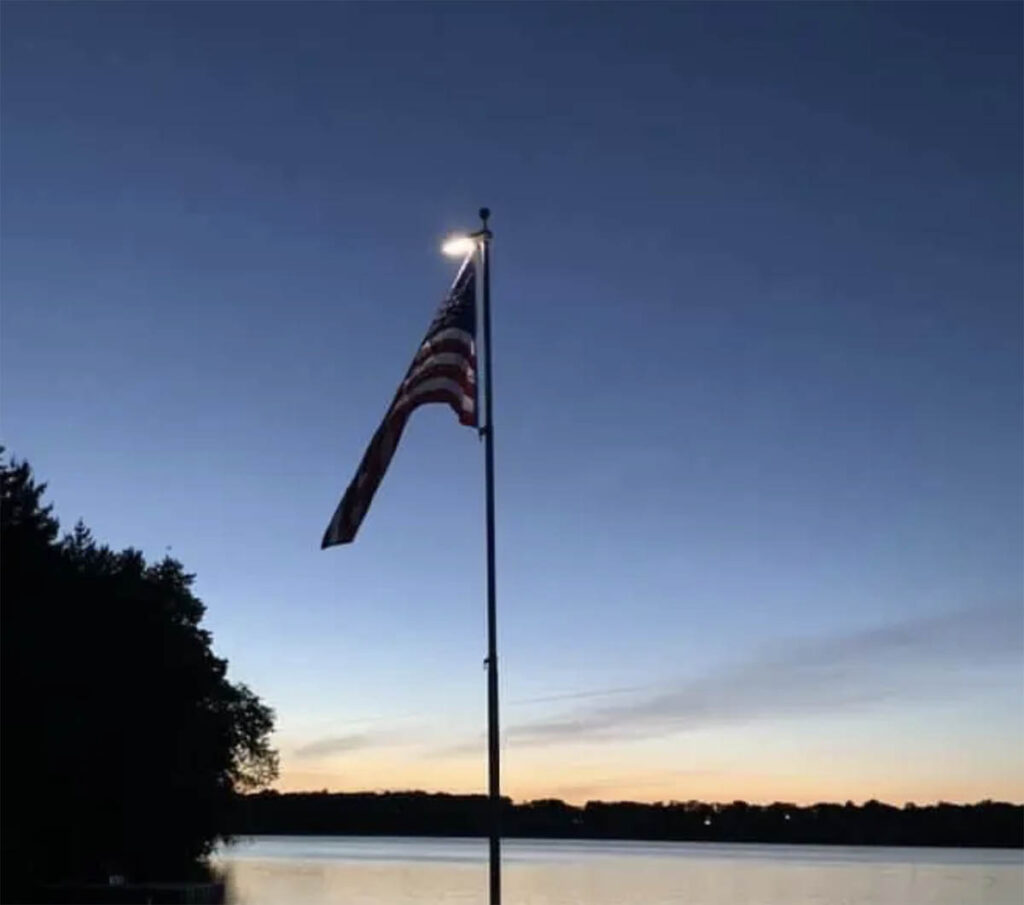


Installing a residential telescoping flagpole is a project that many homeowners can successfully complete themselves. With a little planning and the right tools, you’ll be proudly flying the American flag in just a few hours.
Like any outdoor project, though, a few common mistakes can affect how well your flagpole performs over the years. Fortunately, they’re all easy to avoid with a little preparation.
The location of your flagpole is one of the most important decisions you’ll make.
Ideally, your flag should be visible from the street while still complementing your home’s landscaping. Be sure to look up as well as around. Avoid placing your flagpole beneath power lines or directly under large tree branches that could interfere with the flag or create safety concerns.
Think about how the flag will look from different angles and leave enough room for it to fly freely without contacting nearby trees, fences, buildings, or decorative lighting.
Before digging any hole, always contact your local utility locating service.
Underground electric, gas, water, communications, and irrigation lines may not be visible from the surface. Having utilities marked before you dig is one of the simplest and most important steps you can take to ensure a safe installation.
A quality telescoping flagpole depends on a solid foundation.
If the hole is too shallow, too narrow, or the ground sleeve isn’t properly positioned, the pole may not remain perfectly vertical over time. Carefully following the manufacturer’s installation instructions for hole size, depth, drainage, and concrete placement will help ensure years of reliable performance.
It’s tempting to assume the pole is straight by simply looking at it.
Even a slight lean becomes surprisingly noticeable once the flag is flying. Taking a few extra minutes with a quality level while the concrete is still workable can save years of wishing you had adjusted it.
Not every property experiences the same wind.
Homes on open farmland, hilltops, lakefront property, or wide-open prairie often experience stronger and more consistent winds than homes in established neighborhoods. Selecting the appropriate flag size and following the manufacturer’s recommendations for your area will help your flag and flagpole perform their best.
One of the biggest advantages of a quality telescoping flagpole is its ease of operation.
Unlike traditional rope-and-pulley systems, telescoping flagpoles allow you to raise and lower the flag from ground level. Leave enough room around the base to comfortably operate the pole and perform occasional cleaning or inspections.
Not all flagpoles are built to the same standards.
A quality American-made aluminum telescoping flagpole uses stronger materials, precision machining, durable finishes, and dependable locking mechanisms that are designed for years of outdoor use. While a lower-priced option may seem attractive initially, investing in a well-built flagpole often provides better value over its lifetime.
Most flagpole installation mistakes are completely avoidable. Choosing the right location, building a proper foundation, checking underground utilities, and following the manufacturer’s installation instructions will help ensure your flagpole remains beautiful, safe, and easy to operate for many years.
If you’re investing in a premium telescoping flagpole, it’s worth taking the time to install it correctly the first time. Once it’s in place, you’ll spend far more time enjoying the sight of Old Glory flying proudly than thinking about the installation itself.