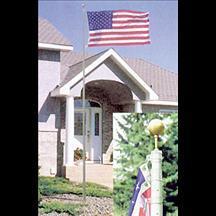


Once you’ve decided to put a flagpole at your home, choosing the height can be surprisingly difficult. Twenty feet sounds tall. Twenty-five feet sounds only slightly taller. Put the two in a yard, however, and that extra five feet can make a noticeable difference.
For most residential installations, both heights can work extremely well. The better choice depends on your house, the size and shape of your property, where the pole will be installed, surrounding trees and buildings, and how visible you want your flag to be.
If you’re deciding between a 20-foot vs. 25-foot flagpole, here’s how to choose the height that will look right once it’s standing in your yard.
For many homes, yes. A 20-foot flagpole is one of the most practical residential sizes because it provides plenty of height and visibility without overwhelming a typical property.
It’s particularly well suited to single-story homes, cabins, lake homes and residential properties where the flagpole will be installed relatively close to the house.
A 20-foot pole can also be a good choice when your yard is moderately sized or when nearby trees, overhead obstacles or property boundaries limit your placement options.
Don’t underestimate how tall 20 feet actually is. When you’re looking at a collapsed pole or a product photo on a website, it’s difficult to appreciate the scale. Once installed vertically in an open yard with a flag flying from the top, a 20-foot pole has substantial presence.
A 25-foot flagpole becomes especially attractive when the surrounding property has more visual scale.
If you have a two-story home, a large yard, a long driveway or considerable distance between the flagpole and the road, those extra five feet can help the pole remain proportional to its surroundings.
A taller pole can also improve visibility when landscaping or other structures would partially obscure a shorter flagpole.
Twenty-five feet isn’t automatically better simply because it’s taller. The goal is to choose a flagpole that looks intentional in the landscape rather than undersized or unnecessarily dominant.
| Consideration | 20-Foot Flagpole | 25-Foot Flagpole |
|---|---|---|
| Typical Residential Use | Excellent for most homes | Best for larger properties and greater visibility |
| Single-Story Home | Usually an excellent fit | May work well on a larger property |
| Two-Story Home | Can work depending on placement | Often better proportionally |
| Smaller Yard | Usually the better choice | Can appear oversized |
| Large/Open Property | Good | Often better |
| Visibility From Road | Very good | Greater visibility at distance |
| Flag Size | 3′ x 5′ is a popular choice | Can accommodate a larger residential flag |
| Wind Exposure | Less height and leverage | Greater exposure should be considered |
Your house provides the most obvious visual reference for determining flagpole height.
A flagpole that looks substantial next to a ranch-style home may look much smaller beside a tall two-story house. Conversely, a very tall flagpole positioned close to a modest single-story home can dominate the property.
As a general guideline, you want the flag to fly clearly above nearby rooflines and visual obstructions without making the pole look out of proportion to the home.
For many single-story houses, 20 feet provides an excellent balance. With taller two-story homes, 25 feet may provide better proportions and make the flag more visible above the roofline.
Placement matters, though. A 20-foot pole installed well away from the house may look entirely different from the same pole positioned near the front entry.
House height is only part of the equation. Your property itself creates visual scale.
On a typical residential lot, a 20-foot flagpole generally has plenty of presence. It can become an obvious focal point without taking over the entire front yard.
On an acre or more of open property, however, a 20-foot pole can visually shrink when viewed from a distance. That’s where a 25-foot pole starts earning its extra height.
The farther the flagpole will be from the house, driveway, road or primary viewing area, the more useful those additional five feet can become.
This is an easy factor to overlook.
If your flagpole will be 30 or 40 feet from the road, a 20-foot pole may provide all the visibility you want. If you have a long driveway and the pole will sit 100 feet or more from the road, a 25-foot flagpole can make the flag noticeably easier to see.
The same principle applies to large rural properties, lake homes and cabins where the primary viewing point may be some distance from the pole.
Think about where you actually want people to see the flag, then consider the flagpole from that viewpoint rather than only from the installation location.
A flagpole needs room to do its job.
Nearby trees can create several problems. They may block the view of the flag, interfere with the flag itself or create an awkward visual backdrop that makes the pole seem shorter than it actually is.
A 25-foot pole can sometimes help get the flag above lower landscaping and smaller ornamental trees, but height isn’t a substitute for proper placement. You still need adequate clearance around the flag.
Remember that trees grow. That small maple 15 feet away may look harmless today and become a considerably larger neighbor years from now.
When possible, choose a location with open sky around the upper portion of the flagpole.
The size of the flag affects how the entire installation looks.
For a 20-foot residential flagpole, a 3′ x 5′ American flag is a popular and well-proportioned choice.
A 25-foot pole gives you the visual scale to use a somewhat larger flag if the flagpole manufacturer permits it, although bigger isn’t always better.
A larger flag creates more wind load on the pole and its hardware. Always follow the flagpole manufacturer’s recommendations regarding maximum flag size and the number of flags that can be flown.
The goal should be proportion. A flag that’s too small can look lost on a tall pole, while an oversized flag can overwhelm the installation and place unnecessary loads on the flagpole.
Height alone doesn’t tell you how much wind a flagpole can withstand.
In fact, a taller pole generally experiences greater leverage and exposure to wind than a shorter version of a similar design. The flag itself adds considerable load as wind speed increases.
That’s why you shouldn’t choose between a 20-foot and 25-foot pole based solely on the assumption that the taller model must somehow be stronger.
Instead, look at the actual construction of the flagpole, including aluminum thickness, base diameter, locking system, foundation requirements and the manufacturer’s recommendations for flag size and severe weather.
One advantage of a quality telescoping flagpole is that it can be lowered when severe weather is approaching rather than remaining at full height.
Never assume that installation requirements are identical simply because two flagpoles come from the same product family.
The ground sleeve, hole dimensions, concrete requirements and installation procedure should match the specific flagpole you’re installing.
Follow the manufacturer’s instructions rather than relying on a generic online formula for how much concrete a flagpole needs.
The foundation isn’t the glamorous part of owning a flagpole, but it’s arguably the most important part of the installation. A beautiful 25-foot flagpole sitting in a poorly installed ground sleeve is still a poorly installed flagpole.
This is particularly important when you’re buying a telescoping flagpole.
You need enough room around the base to comfortably operate the pole, change flags and perform any necessary maintenance. You should also consider nearby landscaping, walls, fences, utility lines and other obstacles.
Before installation, stand where you’re considering placing the flagpole and look upward and outward.
Imagine the pole at full height. Imagine the flag extended horizontally in the wind. Then look at what’s nearby.
A few minutes spent doing this can prevent years of wishing you’d installed the pole six feet farther to the left.
Regardless of which height you choose, safety comes before appearance.
Never install a flagpole where it could contact overhead power lines, either during installation or if the pole were ever to fall. Maintain generous clearance from electrical lines and other overhead utilities.
You also need to know what’s underground before digging the foundation. Utility lines for electricity, gas, communications, irrigation and other services may cross areas that appear completely open from the surface.
Have underground utilities located before you dig.
It can.
A taller flagpole isn’t automatically more impressive. Proportion matters.
Put a 25-foot pole a few feet from a small single-story house on a compact city lot and it may visually overpower everything around it. Put that same flagpole beside a large two-story home on several acres and it may look perfectly natural.
This is why choosing flagpole height purely from a product page can be difficult.
One simple trick is to find a reference point on your house or property with a known approximate height. Compare that visually with 20 and 25 feet. You can also use a tape measure along the ground to get a better sense of just how significant five additional feet actually is.
If you’re stuck between the two sizes, ask yourself four questions:
If you’re dealing with a typical single-story home and residential yard, 20 feet is usually a very safe choice.
If you have a larger two-story home, more open property, greater viewing distances or simply want more visual presence, 25 feet may be the better fit.
There’s no universal winner in the 20-foot vs. 25-foot flagpole debate. The right height is the one that fits your property.
A 20-foot flagpole offers excellent visibility and proportion for many residential installations. It’s substantial without being overwhelming and works particularly well with single-story homes and typical residential lots.
A 25-foot flagpole adds presence and visibility. It can be an excellent choice for larger homes, bigger yards, rural properties and locations where the flag will frequently be viewed from farther away.
Whichever height you choose, don’t make the decision based on height alone. Construction quality, flag size, installation, surrounding obstacles and long-term serviceability matter just as much.
Falls Flag Source offers American-made Presidential Series telescoping flagpoles for residential installations, including both 20-foot and 25-foot options.
Our telescoping flagpoles are built from sturdy aluminum and feature polycarbonate bushings, heavy-duty locking detents and anodized aluminum swivel rings that allow the flag to rotate around the pole. There are no external ropes, chains or pulleys to deal with.
They’re designed to make raising, lowering and changing your flag simple, and they’re backed by a 10-year warranty.
Not sure whether 20 or 25 feet will look right at your home? Give Falls Flag Source a call at (800) 942-2113. Tell us a little about your house, property and where you plan to install the pole, and we’ll help you choose the right size.
Ready to get started? Explore our Presidential Series telescoping flagpoles and find the height, model and finish that fits your home.